10 Best Reciprocating Saws (November 2026)
The best reciprocating saws include the DeWalt DCS369B Atomic Recip Saw for tight spaces, the Milwaukee 2719-20 M18 FUEL Hackzall for M18 service work, and the DeWalt 20V MAX XR Recip Saw for cuts between studs.
On this page (8 sections)
- How we chose the best reciprocating saws
- Which best reciprocating saw fits each job?
- How do you choose the right saw format and power source?
- Which blades should you buy with the saw?
- How should you set up the saw before the first cut?
- Which mistakes cause rough cuts, binding and worn blades?
- How do you care for a reciprocating saw?
- Which best reciprocating saw should you buy?
The DeWalt DCS369B Atomic Recip Saw is the best reciprocating saw here for cramped repairs and compact handling. Choose the corded DeWalt DWE305 for long sessions near an outlet, or the DCS384B for demanding cordless demolition.
Start with your most common cut. Removing a short pipe in a cabinet calls for different handling than breaking down framing in an open room.
A reciprocating saw excels at rough cuts where access matters more than a neat edge. It isn't the right first choice for furniture joints, smooth curves or cuts that need a clean finish.
For tool types and terminology, start with our complete guide to reciprocating saws and multi-tools. Our guide to what a reciprocating saw is used for helps match the tool to the task.
Our picks at a glance
-
1

-
2

-
3
- 4
 Check it
DeWalt 12 Amp Corded Recip Saw
Best for outlet-based demolition - 5
 Best for flush cuttingCheck it
- 6
 Best for M18 demolition crewsCheck it
- 7
 Check it
Milwaukee 2625-20 M18 Hackzall
Best for overhead repair jobs - 8
 Check it
Black+Decker BDCR20C Recip Saw Kit
Best for first-time cordless buyers - 9
 Best for demanding cordless demolitionCheck it
- 10
 Best for existing V20 usersCheck it
How we chose the best reciprocating saws
We compared working access, blade control and power setup to match these saws with specific jobs. A compact repair saw ranks well for access, while a demolition-focused model can be the better choice for sustained heavy work.
Body length affects where you can place the tool, but blade orientation and shoe contact matter too. A short saw still needs room for its battery, your gripping hand and the blade's full movement.
We also considered the equipment needed to start work. Most cordless choices here are bare tools; the Black+Decker kit includes the battery and charger.
The scores reflect each saw's features and fit for this guide. Use the buyer descriptions below to choose among them, since the highest-scoring compact saw won't suit every demolition job.
| Product | Best for | Power | Format | Blade clamp | Our score |
|---|---|---|---|---|---|
| DeWalt DCS369B Atomic Recip Saw | tight spaces | 20V MAX battery, sold separately | Compact, one-handed | Tool-free release | 9.3 |
| Milwaukee 2719-20 M18 FUEL Hackzall | M18 service work | M18 battery, sold separately | One-handed Hackzall | 9.1 | |
| DeWalt 20V MAX XR Recip Saw | cuts between studs | 20V MAX battery, sold separately | Compact body | Keyless, four-position | 9.0 |
| DeWalt 12 Amp Corded Recip Saw | outlet-based demolition | 12 amp corded | Corded reciprocating saw | Four-position, lever-action | 8.8 |
| DeWalt 20V MAX Recip Saw | flush cutting | 20V MAX battery, sold separately | Cordless reciprocating saw | Tool-free, four-position | 8.7 |
| Milwaukee M18 FUEL Sawzall | M18 demolition crews | M18 battery, sold separately | Sawzall, model 2821-20 | Lever actuated | 8.6 |
| Milwaukee 2625-20 M18 Hackzall | overhead repair jobs | M18 battery, sold separately | Compact, one-handed | QUIK-LOK | 8.4 |
| Black+Decker BDCR20C Recip Saw Kit | first-time cordless buyers | 20V MAX battery, included | Cordless starter kit | 8.2 | |
| DeWalt DCS384B XR Recip Saw | demanding cordless demolition | 20V MAX battery, sold separately | Demolition-focused cordless saw | Keyless, lever-action | 8.0 |
| Craftsman V20 Recip Saw | existing V20 users | V20 battery, sold separately | Compact cordless saw | 8.0 |
Which best reciprocating saw fits each job?
Choose by the cuts you repeat most often, then use battery compatibility to narrow the field. Each model below has a clear reason to buy it and a situation where another format makes more sense.
DeWalt DCS369B Atomic Recip Saw: Best for tight spaces
- 12.5 in front-to-back length
- Brushless motor
- Variable-speed trigger
- Pivoting shoe
Choose this compact saw for repairs where the handle and battery must fit around nearby surfaces. Its LED helps light enclosed work areas.
Pros
- Short body for cramped access
- Variable-speed control
- Tool-free blade release
Cons
- Battery and charger sold separately
- Compact handling is its main reason to choose it over demolition-focused models
Choose the DCS369B for repairs where getting the saw into position is the hard part. Its 12.5 in front-to-back body helps when surrounding framing, cabinets or fixtures limit handle clearance.
The brushless motor, variable-speed trigger and pivoting shoe support controlled starts in that small format. An LED lights the immediate work area, but you'll still need enough room to see the blade's exit path.
This is a strong fit for an existing DeWalt user who makes scattered repair cuts. The package includes 2 blades and a belt hook; add compatible charging equipment if you're starting from scratch.
Skip it as your first choice if your work is mostly repeated demolition in open space. A larger format deserves priority when compact access brings little benefit.
Our DeWalt DCS369B review takes a closer look at its one-handed layout.
Milwaukee 2719-20 M18 FUEL Hackzall: Best for M18 service work
- One-handed design
- Brushless motor
- 7/8 in stroke length
- Pivoting shoe
An option for M18 users making repair cuts in confined areas. The pivoting shoe helps maintain contact as the cutting angle changes.
Pros
- Compact one-handed format
- Brushless motor
- Pivoting shoe
Cons
- Bare tool
- Not the first choice when you want a full-size demolition format
Choose the 2719-20 for M18 repair and service work in confined areas. It combines a one-handed layout with a brushless motor and a 7/8 in stroke.
The pivoting shoe helps keep the tool braced as your approach angle changes. Milwaukee also includes overload protection through its REDLINK Plus electronics, which doesn't replace backing off when a blade binds.
This model makes the most sense when you already have compatible batteries and want a compact saw for smaller cuts. Secure pipes or other loose material before cutting, rather than using your free hand to hold them near the blade.
Skip it if your main goal is a full-size demolition saw, or if your existing battery collection points toward another brand.
Our Hackzall vs Sawzall comparison explains which Milwaukee format suits each kind of work.
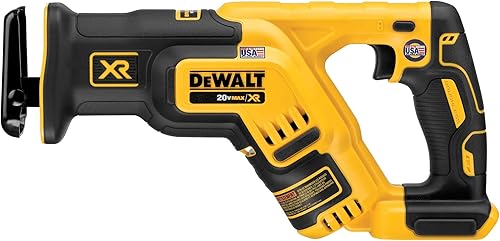
DeWalt 20V MAX XR Recip Saw: Best for cuts between studs
- 14.5 in length
- Brushless motor
- 1-1/8 in stroke length
- Four-position blade clamp
The DCS367B combines a compact body with several blade orientations for work around framing. Choose it when both saw clearance and handle position matter.
Pros
- Compact body
- Four blade positions
- Built-in LED
Cons
- Battery and charger sold separately
- Not a one-handed Atomic model
Choose the DCS367B when you need compact access and several blade orientations. Its 14.5 in body suits work between studs, while the four-position clamp gives you more ways to approach a nearby surface.
The brushless motor drives a 1-1/8 in stroke, and the variable-speed trigger reaches up to 2,900 SPM. An LED helps you see the starting point in enclosed framing.
This is the DeWalt option to consider when a conventional handle position would put your knuckles or the saw body against an obstruction. Changing blade orientation can improve the approach without forcing your wrist into an awkward angle.
Skip it if one-handed positioning is your main need; the Atomic has the more suitable format for that priority. Buyers starting a new cordless setup must also allow for a battery and charger.
DeWalt 12 Amp Corded Recip Saw: Best for outlet-based demolition
- 12 amp motor
- 1-1/8 in stroke length
- Four-position blade clamp
- Variable-speed trigger
Choose the DWE305 for repeated cutting within reach of an outlet. It avoids battery changes and offers several blade positions for awkward approaches.
Pros
- No battery charging required
- Four-position blade clamp
- Keyless blade changes
Cons
- Requires outlet access
- Cord needs a clear route through the work area
Choose the DWE305 for repeated cutting near reliable power. Its 12 amp corded motor removes charging and battery swaps from the work schedule.
The four-position blade clamp supports different approaches, including flush cuts. A keyless lever makes changes straightforward, and the variable-speed trigger lets you ease into the material before increasing speed.
This is a sensible format for demolition concentrated in one room or a workshop where you can arrange a clear cord route. It also avoids buying into a battery platform for a tool you might use only on occasional large projects.
Skip it when your cuts are scattered across a property or an extension cord would cross access routes. Its 8 lb weight also deserves attention if much of your work is above shoulder height.
Use a cord rated for the tool and distance, following the manual.
DeWalt 20V MAX Recip Saw: Best for flush cutting
- Four-position blade clamp
- 1-1/8 in stroke length
- Variable-speed trigger
- Adjustable pivoting shoe
The DCS380B suits work close to surrounding surfaces, with several blade positions and an adjustable shoe. It makes sense for buyers already using compatible DeWalt batteries.
Pros
- Four blade positions
- Adjustable pivoting shoe
- Variable-speed trigger
Cons
- Battery and charger sold separately
- Flush cuts still need a suitable blade and clear working space
Choose the DCS380B for blade-position flexibility close to surfaces. Its four-position clamp supports flush cutting, and the adjustable pivoting shoe lets you change how the blade meets the work.
Moving the shoe can also shift the section of teeth doing the cutting. That helps spread wear along a suitable blade, provided the tip still clears the material throughout the stroke.
The variable-speed trigger reaches up to 3,000 SPM, paired with a 1-1/8 in stroke. Existing DeWalt users have a straightforward reason to consider this bare tool without adding a new charging system.
Skip it if compact one-handed access is the deciding factor, or choose the DCS367B when its compact body better fits your work area.
Our guide to choosing a cordless reciprocating saw explains how battery fit and tool format affect the choice.
Milwaukee M18 FUEL Sawzall: Best for M18 demolition crews
- Brushless motor
- Built-in LED
- Lever-actuated blade clamp
- Metal-reinforced battery connection
This Sawzall suits M18 users choosing a demolition tool rather than a compact Hackzall. Its reinforced battery connection is designed to improve retention and durability.
Pros
- Brushless motor
- Work-surface LED
- Lever-actuated blade changes
Cons
- Battery and charger sold separately
- Less suited to buyers whose main need is one-handed positioning
Choose the M18 FUEL Sawzall when you want a demolition-focused addition to an M18 setup. The 2821-20 combines a brushless motor with a lever-actuated blade clamp.
Its metal-reinforced battery connection addresses a practical concern on a frequently moved cordless tool. Milwaukee designed that connection to improve battery retention and durability.
The built-in LED lights the work surface during a cut. Use separate work lighting when shadows hide the back of the material or nearby obstacles.
This is a better match for buyers seeking the Sawzall format than for someone choosing a compact service saw. Battery and charger are separate, so existing M18 equipment strengthens its appeal.
Skip it if most cuts happen inside cabinets or require the positioning freedom of a one-handed Hackzall. For those jobs, compare the 2719-20 before choosing around the Sawzall name alone.
Milwaukee 2625-20 M18 Hackzall: Best for overhead repair jobs
- One-handed design
- M18 compatible
- Built-in LED
- QUIK-LOK blade clamp
The compact Hackzall format suits occasional overhead repairs and cuts in confined spaces. Existing M18 users can add it without starting another battery platform.
Pros
- Compact positioning
- Built-in LED
- Tool-free blade changes
Cons
- Bare tool
- Shorter stroke than the 2719-20
Choose the 2625-20 for compact M18 repair work, including occasional cuts above shoulder height. Its one-handed layout lets you position the tool without the footprint of a conventional larger saw.
The QUIK-LOK clamp allows tool-free blade changes, and an LED helps light the cut. Milwaukee's anti-vibration design aims to reduce vibration during use.
Its 3/4 in stroke is shorter than the 2719-20's. That gives you a useful design difference to compare, though stroke length alone can't rank cutting speed across materials.
This bare tool suits an M18 owner whose priority is access for small repairs. Keep overhead sessions short enough to maintain a stable stance and controlled grip.
Skip it for a purchase centered on prolonged demolition. Choose the 2719-20 if you specifically want the brushless Hackzall option described above.
Black+Decker BDCR20C Recip Saw Kit: Best for first-time cordless buyers
- Battery and charger included
- Tool-free blade change
- Pivoting shoe
- Variable-speed trigger
This kit gives a new cordless buyer the saw and charging equipment together. It suits occasional household cutting without an existing battery collection.
Pros
- Battery and charger included
- Tool-free blade changes
- Electric brake
Cons
- Only 1 blade included
- Battery capacity and spare-pack needs matter for longer projects
Choose the BDCR20C when you need a first cordless saw with charging equipment. The kit includes the saw, battery, charger and 1 blade, so you don't have to assemble those parts separately.
Its variable-speed trigger, pivoting shoe and tool-free blade changes cover the basic controls needed for household rough cuts. The electric brake adds another control feature, but always wait for the blade to stop before setting the saw down.
This package suits occasional repairs where buying a bare tool would leave you without a way to power it. Check the included blade against your first job and add material-specific blades as needed.
Skip it if you're already equipped with another battery platform and can buy a suitable bare tool. For long projects, plan charging breaks and spare-pack needs before choosing around the kit's convenience.
DeWalt DCS384B XR Recip Saw: Best for demanding cordless demolition
- Brushless motor
- 1-1/8 in stroke length
- Up to 3,000 SPM, no-load
- Counterbalance mechanism
Choose the DCS384B for demanding cuts where cordless movement matters. DeWalt designed its counterbalance mechanism to limit vibration.
Pros
- Brushless motor
- Vibration-reduction mechanism
- Onboard LED
Cons
- Battery and charger sold separately
- Less compact than the Atomic and DCS367B
Choose the DCS384B for demanding cordless demolition, especially if you already use DeWalt batteries. Its brushless motor drives a 1-1/8 in stroke at up to 3,000 SPM with no load.
DeWalt designed the counterbalance mechanism to limit vibration. That feature is worth considering for repeated cutting, alongside your ability to brace the shoe and maintain a secure grip.
A keyless lever-action clamp simplifies blade changes, while the pivoting shoe supports contact at different approach angles. The package includes a wood-cutting blade; battery and charger are separate.
This is the DeWalt model to put ahead of the Atomic when your work favors demanding cuts over compact access. Its 19.3 in body needs more room around the work.
Skip it when you mostly make short repairs in crowded spaces. A smaller saw is easier to justify when most of that larger footprint gets in your way.
Craftsman V20 Recip Saw: Best for existing V20 users
- V20 cordless system
- 1 in stroke length
- Variable-speed trigger
- Tool-free blade release
A practical addition for Craftsman V20 owners doing household repairs and rough cuts. Its compact body helps when working between studs.
Pros
- Tool-free blade release
- Contoured overmolded handle
- Compact body
Cons
- Battery and charger sold separately
- Less reason to choose it if you use another battery platform
Choose the Craftsman V20 saw when your compatible batteries are already on the shelf. It adds rough-cutting capability without another charger or battery system.
The motor uses a 1 in stroke, and the variable-speed trigger lets you control the start. Tool-free blade release helps when a project moves between materials that need different teeth.
Its compact body suits work between studs, while the contoured overmolded handle gives you a defined gripping surface. A 6 in blade comes with the bare tool, so check its suitability before the first cut.
This model fits household repairs and occasional removal work for V20 owners. Keep room for the attached battery when checking access around framing.
Skip it if you don't use V20 and another pick better matches your job. Battery compatibility is a reason to choose it, rather than a reason to overlook a poor fit.
How do you choose the right saw format and power source?
Choose the format that fits your working position, then decide how to power it. A saw that needs an awkward wrist angle or can't keep its shoe against the work is a poor match, regardless of motor features.
Which best reciprocating saw format suits your work?
A compact one-handed format suits scattered repairs, crowded spaces and short cuts at awkward angles. A larger format is worth considering when most work is demolition with room for a stable two-handed stance.
“One-handed” describes the tool design, not permission to hold the work beside a moving blade. Clamp loose material and follow the manual's gripping instructions.
Check the space with the intended blade and battery fitted. Body length alone leaves out the clearance needed for your hand, blade travel and safe withdrawal after the cut.
When should you buy cordless?
Choose cordless for jobs spread across different rooms, outdoor repairs or work beyond convenient outlet reach. Existing compatible batteries can make a bare tool a sensible addition.
Match the exact battery system, not just the voltage number. Similar voltage labels don't make DeWalt, Milwaukee, Black+Decker and Craftsman packs interchangeable.
Larger-capacity packs can add useful runtime but also change weight and balance. Choose enough capacity for the work without making an overhead or confined cut harder to control.
Our cordless reciprocating saw guide covers these choices in more detail.
When should you buy corded?
Choose corded for concentrated work where a suitable outlet and clear cord route are available. It removes charging breaks, but the cord becomes part of every move around the work.
Check extension-cord requirements in the manual, including cord size and length. Keep connections away from wet areas and use appropriate electrical protection for the location.
Neither power source removes the need for breaks. Stop when fatigue makes it hard to keep the shoe braced or the blade aligned.
Which blades should you buy with the saw?
Buy blades for your materials, rather than relying on one general blade for every job. The right teeth and usable length often solve cutting problems more directly than changing the saw.
Use a wood blade for clean lumber and a blade rated for embedded nails when cutting demolition wood. Metal-cutting blades need teeth suited to the material and thickness.
Fine teeth help maintain engagement on thin metal, while coarse teeth clear chips from wood. For pipe, consider wall thickness as well as the pipe's outside diameter.
Choose enough blade length to clear the far side throughout the full stroke. An unnecessarily long blade flexes more easily and can strike hidden objects behind the work.
For occasional mixed repairs, start with suitable wood and metal blades, then add specialty blades as jobs require. Our guide to cutting metal with a reciprocating saw explains blade choice and cut control.
Stroke rate and stroke length describe blade movement, not a guaranteed cutting result. Sharp teeth, steady support and appropriate feed pressure all matter.
How should you set up the saw before the first cut?
Set up by checking the work, fitting the correct blade and securing the material before connecting power. A controlled cut starts before you pull the trigger.
- Inspect the cut area. Check both sides for wiring, pipes, screws and anything the blade tip could reach.
- Isolate hazards. Have electrical circuits or services safely isolated where the job requires it; don't cut into an unknown wall cavity.
- Support the work. Clamp loose pieces and support offcuts so they can't drop, twist or pinch the blade.
- Disconnect the saw. Remove its battery or unplug it before fitting blades or adjusting the shoe.
- Seat the blade fully. Close the clamp as instructed, then check that the blade is secure while power remains disconnected.
- Plan the finish. Decide where the offcut will go and how you'll stop without striking nearby surfaces.
Wear eye protection and use suitable hearing protection. Plan dust control for the material, and stop if demolition reveals a material that may need specialist handling.
Set the shoe against the work where the cut allows. Start slowly to establish the cut, then adjust speed and pressure to the blade and material.
Keep your face and free hand away from the blade's path, including the far side. Wait for movement to stop before withdrawing a blade that could catch on the cut edge.
Our guide to using a reciprocating saw explains the cutting sequence. For clamp steps and blade handling, see how to change a reciprocating saw blade.
Which mistakes cause rough cuts, binding and worn blades?
The most common problems come from poor support, excess pressure and the wrong blade. Correct the setup before assuming you need a more powerful saw.
Pushing harder when progress slows
Let sharp teeth remove the material instead of forcing the saw forward. Excess pressure can bend the blade, increase heat and make the tool harder to control.
If progress suddenly slows, stop and check for dull teeth, a pinched cut or an unexpected material. Disconnect power before clearing the problem.
Letting the shoe bounce above the work
Keep the shoe braced wherever the cut permits. Holding the saw away from the material lets the work shake and makes a controlled start harder.
Don't force contact by twisting your wrist or leaning off balance. Reposition the work or choose another approach.
Treating flush cuts as finish cuts
A blade positioned close to a surface can still scratch or gouge it. Check clearance and use a suitable flexible blade when the cut requires one.
Choose another tool when preserving a finished surface matters more than fast removal. Don't bend a blade sharply to force an approach it can't safely follow.
Running every material at full speed
Use the trigger to establish the cut and follow the blade's speed guidance. Metal and heat-sensitive materials often call for a different approach than rough wood removal.
Stop if the blade overheats or cuts poorly. More trigger pressure won't restore worn teeth.
How do you care for a reciprocating saw?
Keep the clamp, vents and blades clean, and inspect the saw before storage. Disconnect power and let the blade cool before handling it.
Remove chips and debris using the method in the manual. Don't add oil or spray cleaners into the clamp or housing unless the manufacturer directs you to do so.
Check blades for bends, cracks and worn teeth. Replace damaged blades rather than trying to straighten them for another cut.
Inspect the shoe, cord or battery connection for damage. If a clamp no longer holds securely, stop using the saw until the fault is resolved.
Store blades so their teeth can't damage cords or loose battery packs. Keep the tool and charging equipment dry, and follow the battery manual's storage guidance.
Which best reciprocating saw should you buy?
The best reciprocating saw is the one that fits your usual cut without creating an access or power problem. Choose the DCS369B for cramped repairs, the DCS367B for framing access with several blade orientations, or the DWE305 for extended work near an outlet.
For demanding cordless demolition, put the DCS384B on your shortlist if you use DeWalt batteries, or the M18 FUEL Sawzall if you use Milwaukee. Choose the Black+Decker kit when you need charging equipment with your first cordless saw.
Before ordering, identify your first material, choose a suitable blade and account for the complete power setup. If you're still deciding which tool belongs in your kit, our guide to reciprocating saws and multi-tools explains their different roles.
Our top 3 picks at a glance
-
1
-
2
-
3
Frequently asked questions
What is the best reciprocating saw for most people?
The DeWalt DCS369B is the best reciprocating saw here for compact repair work, especially if you already own compatible batteries. Choose a demolition-focused model for frequent heavy cuts, or the corded DWE305 for extended cutting near an outlet; your usual job matters more than the highest score.
Should I choose a one-handed or full-size reciprocating saw?
Choose a one-handed model for confined access and short repair cuts; choose a full-size format when repeated demolition is the main job. Check handle clearance with the battery attached and blade installed; follow the manual's grip instructions, secure the workpiece and keep your free hand away from the cutting area.
Is a corded reciprocating saw better than cordless?
A corded saw is better suited to long sessions near reliable power because it avoids charging breaks; cordless is more convenient for scattered repairs and work away from outlets. Include batteries, charging equipment and any suitable extension cord in your buying decision, then choose the setup that fits your work area.
What should I check before buying a reciprocating saw?
Check working clearance, power source, blade compatibility and what comes in the box; a bare tool needs a compatible battery and charger, while a starter kit may still need blades for different materials. For demolition, also plan how you'll support the work and check for hidden wiring or pipes.


