9 Best Cordless Reciprocating Saws (November 2026)
The best cordless reciprocating saws include the DeWalt DCS369B Atomic Recip Saw for cramped repair spaces, the Milwaukee 2719-20 M18 FUEL Hackzall for M18 repair work, and the DeWalt 20V MAX XR Recip Saw for work between studs.
On this page (10 sections)
- How we chose the best cordless reciprocating saws
- Best cordless reciprocating saws for different jobs
- Which cordless reciprocating saw format should you choose?
- Do you need a battery and charger?
- What features matter beyond maximum blade speed?
- Which blade should you use for wood, metal or pipe?
- How should you set up the saw before the first cut?
- Which mistakes cause rough cuts and early blade wear?
- How do you care for a cordless reciprocating saw?
- Which best cordless reciprocating saw fits your next job?
The DeWalt DCS369B Atomic Recip Saw is our best cordless reciprocating saw for compact repair cuts. Choose a larger demolition model if you'll spend more time removing framing than reaching into cramped spaces.
Battery ownership should narrow your shortlist early. The Milwaukee Hackzalls suit M18 repair setups, the DeWalt DCS384B targets demanding cuts, and the Black+Decker kit includes the battery and charger a new buyer needs.
Start with our complete guide to reciprocating saws and multi-tools if you're choosing a tool type. Our best reciprocating saws page compares corded and cordless options, while the cordless reciprocating saw buying guide covers platform choices.
Our picks at a glance
-
1

-
2

-
3
- 4
 Best for awkward flush cutsCheck it
- 5
 Best for M18 demolition workCheck it
- 6
 Check it
Milwaukee 2625-20 M18 Hackzall
Best for occasional overhead cuts - 7
 Check it
Black+Decker BDCR20C Recip Saw Kit
Best for first-time DIY buyers - 8
 Best for demanding demolition jobsCheck it
- 9
 Best for V20 tool ownersCheck it
How we chose the best cordless reciprocating saws
We compared access, controls, blade clamps and battery needs, favoring compact repair tools at the top. A lower-ranked demolition saw can still be the better choice for a buyer whose main job is tearing out framing.
Body length matters when a wall, cabinet or pipe blocks your approach. Blade orientation and shoe adjustment matter when you need to keep the tool supported without twisting your wrist.
We also separated complete kits from bare tools. An existing battery platform can make a tool-only saw a sensible addition, while a first-time buyer needs to account for the whole working setup.
| Product | Best for | Format | Motor | Blade changes | Our score |
|---|---|---|---|---|---|
| DeWalt DCS369B Atomic Recip Saw | cramped repair spaces | Compact one-handed | Brushless | Tool-free release | 9.3 |
| Milwaukee 2719-20 M18 FUEL Hackzall | M18 repair work | One-handed | Brushless | 9.1 | |
| DeWalt 20V MAX XR Recip Saw | work between studs | Compact | Brushless | Keyless four-position clamp | 9.0 |
| DeWalt 20V MAX Recip Saw | awkward flush cuts | Tool-free four-position clamp | 8.7 | ||
| Milwaukee M18 FUEL Sawzall | M18 demolition work | Brushless | Lever-actuated clamp | 8.6 | |
| Milwaukee 2625-20 M18 Hackzall | occasional overhead cuts | One-handed | Tool-free QUIK-LOK clamp | 8.4 | |
| Black+Decker BDCR20C Recip Saw Kit | first-time DIY buyers | Tool-free | 8.2 | ||
| DeWalt DCS384B XR Recip Saw | demanding demolition jobs | Brushless | Keyless lever-action clamp | 8.0 | |
| Craftsman V20 Recip Saw | V20 tool owners | Tool-free release | 8.0 |
Best cordless reciprocating saws for different jobs
Choose the Atomic for compact access, then use the notes below to match the other saws to your workload. Each recommendation includes a reason to buy and a reason to move on.
DeWalt DCS369B Atomic: best cordless reciprocating saw for compact repairs
DeWalt DCS369B Atomic Recip Saw: Best for cramped repair spaces
- One-handed design
- Brushless motor
- LED work light
- Pivoting shoe
Choose the Atomic for repair cuts where a short body helps you reach the work. It favors access and positioning over the longer format of a demolition saw.
Pros
- Short body for restricted access
- Variable-speed trigger
- Includes two blades and a belt hook
Cons
- Battery and charger sold separately
- Not the first choice for sustained demolition
The DCS369B suits repairs where the saw must reach around an obstruction rather than simply drive through an open cut. Its 12.5 in front-to-back body gives it a clear role in this group.
The variable-speed trigger lets you start gently before increasing speed. Keep the pivoting shoe against the work so the blade cuts instead of pushing the saw back and forth.
DeWalt says the tool is 37% lighter than the DCS367 without batteries. That makes it worth considering for awkward positioning, although the battery you attach still affects balance.
Two blades and a belt hook are included. Add blades suited to your actual materials rather than expecting the included pair to cover every repair.
Buy this for short, scattered cuts in restricted spaces, especially if you already use compatible DeWalt equipment. Skip it as your first choice for sustained demolition, where a larger format deserves priority.
Milwaukee 2719-20 M18 FUEL Hackzall: for M18 repair work
Milwaukee 2719-20 M18 FUEL Hackzall: Best for M18 repair work
- One-handed design
- Brushless motor
- Pivoting shoe
- REDLINK Plus electronics
This is the one-handed M18 choice for buyers who want a brushless motor and a shoe that follows the work surface. It suits repair work with awkward access.
Pros
- One-handed positioning
- Pivoting shoe
- Overload protection
Cons
- Bare tool
- Shorter stroke than the larger DeWalt options
The 2719-20 is the one-handed M18 choice for buyers who want a brushless repair saw. It makes more sense than changing battery systems just to gain a slightly different compact shape.
Its 7/8 in stroke and pivoting shoe suit a range of cutting positions. Milwaukee's REDLINK Plus electronics provide overload protection, but you should still ease off if the blade binds.
The compact format helps when a conventional saw's rear handle would crowd your approach. It doesn't make holding loose pipe or lumber with your free hand a sound setup.
Choose it for repeated repair cuts where access changes from job to job. Skip it if your usual task is open demolition and you have room to support a larger saw with both hands.
Our 2719-20 Hackzall review takes a closer look at its role. If you're deciding between platforms, compare the DCS369B review before adding another charger.
DeWalt DCS367B XR: for work between studs
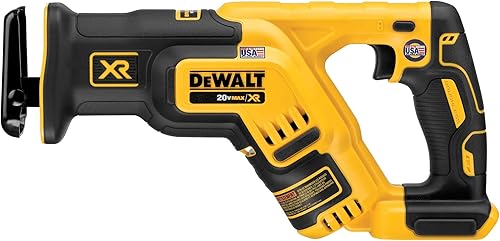
DeWalt 20V MAX XR Recip Saw: Best for work between studs
- Compact body
- Brushless motor
- Four-position blade clamp
- LED light
The DCS367B balances access between studs with a longer stroke and multiple blade orientations. Choose it when blade position matters as much as body length.
Pros
- Designed for access between studs
- Four blade positions
- Variable-speed trigger and LED
Cons
- Battery and charger sold separately
- Needs more clearance than the Atomic
The DCS367B is the choice when you want compact stud access with blade-position options. Its 14.5 in body and four-position clamp give you more ways to approach framing than a fixed blade orientation.
The 1-1/8 in stroke pairs with a variable-speed trigger reaching 2,900 SPM. Those figures describe blade motion; the blade's teeth and the material still determine how you should feed the cut.
A different clamp position can help keep the handle clear of nearby framing. It is especially useful when rotating the entire saw would put your wrist or battery against an obstacle.
The brushless motor and LED round out a tool aimed at varied repair and removal work. It uses DeWalt 20V MAX batteries and chargers, sold separately.
Choose it when you regularly switch between open cuts and confined framing. Skip it if the shortest possible body is your main need, since the Atomic takes up less front-to-back space.
DeWalt DCS380B: for awkward flush cuts
DeWalt 20V MAX Recip Saw: Best for awkward flush cuts
- Four-position blade clamp
- Adjustable pivoting shoe
- Variable-speed trigger
- Rubber overmolded grip
The DCS380B suits rough removal work where blade orientation and shoe adjustment help you approach the cut. Its clamp supports flush-cutting setups.
Pros
- Four blade positions
- Adjustable shoe
- Tool-free blade changes
Cons
- Battery and charger sold separately
- Less suited to buyers seeking a one-handed format
The DCS380B suits removal jobs where blade angle and shoe adjustment help you reach the cut. Its four-position clamp supports flush-cutting arrangements without requiring you to rotate the whole saw.
The adjustable pivoting shoe lets you change how far the blade projects beyond the contact point. On suitable cuts, shifting the shoe can also bring a less-worn section of teeth into use.
Its 1-1/8 in stroke and speed range up to 3,000 SPM provide a conventional reciprocating-saw setup. Start slowly near a finished surface, where a jumping blade can mark more than the intended cut.
Choose this when you expect to remove material beside framing or vary cutting depth often. Use a blade intended for the task, and remember that a flush cut can still scratch the adjacent surface.
Skip it if compact one-handed positioning is the deciding factor. For a compact body with the same number of blade orientations, the DCS367B is the closer comparison.
Milwaukee M18 FUEL Sawzall: for an M18 demolition setup
Milwaukee M18 FUEL Sawzall: Best for M18 demolition work
- Brushless motor
- Built-in LED
- Lever-actuated blade clamp
- Reinforced battery connection
Choose this Sawzall for a conventional demolition setup within the M18 platform. Its reinforced battery connection and lever clamp address repeated handling and blade swaps.
Pros
- Brushless motor
- LED for shadowed cuts
- Metal-reinforced battery connection
Cons
- Battery and charger excluded
- Less appealing for repeated overhead cuts
The M18 FUEL Sawzall, model 2821-20, suits buyers who want a conventional demolition saw on M18. Choose it over a Hackzall when your work allows a stable two-handed stance and involves repeated removal cuts.
The brushless motor is paired with a lever-actuated blade clamp. That clamp is useful when a job shifts from wood to metal and calls for a blade change rather than forcing one blade through everything.
Milwaukee designed the metal-reinforced battery connection for improved durability and battery retention. Even so, remove the battery before clearing debris or handling the blade clamp.
The tool weighs 6.8 lb, so think about where you'll hold it during a job. Repeated cuts above shoulder height put different demands on you than cutting supported material near waist level.
Buy it for an existing M18 demolition setup. Skip it if your typical work is a few awkward repair cuts, where one of the Hackzalls is the more suitable format.
Milwaukee 2625-20 M18 Hackzall: for occasional overhead cuts
Milwaukee 2625-20 M18 Hackzall: Best for occasional overhead cuts
- One-handed design
- Anti-vibration handle
- QUIK-LOK blade clamp
- LED light
This compact Hackzall suits occasional repair cuts above shoulder height or in restricted spaces. It works with M18 compact and XC lithium-ion batteries.
Pros
- Compact one-handed format
- Anti-vibration system
- Tool-free blade changes
Cons
- Bare tool
- Shorter stroke than the 2719-20
The 2625-20 suits M18 users who need a compact saw for occasional awkward cuts. Its one-handed shape helps with positioning around obstructions or above shoulder height.
Milwaukee equips it with an anti-vibration system and an LED. Those features help with handling and visibility, but good support and firm shoe contact still matter.
The saw has a 3/4 in stroke and a speed range of 0–3,000 SPM. Its QUIK-LOK clamp accepts Sawzall and Hackzall blades, making blade selection a practical way to adapt it to different materials.
It works with M18 compact and XC lithium-ion batteries. Consider the size of the attached pack when planning access, since a bulky battery can obstruct a space the bare tool would fit.
Choose it for scattered home or jobsite repairs within an existing M18 setup. Skip it if you specifically want the 2719-20's brushless motor and longer stroke, or need a larger saw for sustained removal work.
Black+Decker BDCR20C: for first-time DIY buyers
Black+Decker BDCR20C Recip Saw Kit: Best for first-time DIY buyers
- Battery and charger included
- Tool-free blade change
- Pivoting shoe
- Electric brake
This kit gives occasional DIY users a saw, battery and charger together. It is the simplest starting point here if you have no compatible cordless equipment.
Pros
- Complete battery-and-charger kit
- Pivoting shoe
- Variable-speed control
Cons
- Not the first choice for sustained demolition
- International versions may differ
The BDCR20C is the clearest starting point here for a buyer with no compatible battery or charger. The kit includes both, plus a reciprocating blade.
Its variable-speed trigger, electric brake and pivoting shoe give you useful controls for general DIY cuts. The brake helps stop blade motion, but always wait for a complete stop before setting the tool down.
The body measures 15.62 in long, so don't choose it expecting the reach of a compact one-handed saw. Allow room behind the tool as well as in front of the blade.
Buy it for occasional removal and repair tasks when a complete kit is the priority. Plan to add material-specific blades, especially if your projects include both wood and metal.
Skip it if sustained demolition is your main workload or you already have a suitable battery platform elsewhere. International versions may differ, so check the exact package before ordering.
DeWalt DCS384B XR: for demanding demolition jobs
DeWalt DCS384B XR Recip Saw: Best for demanding demolition jobs
- Brushless motor
- Counterbalance mechanism
- Pivoting shoe
- Onboard LED
The DCS384B targets demanding cuts where there is room for a longer saw. Its counterbalance mechanism is designed to limit vibration during work.
Pros
- Brushless motor
- Vibration-reduction mechanism
- Variable-speed trigger
Cons
- Battery and charger sold separately
- Long body needs more working room
The DCS384B is the DeWalt option to prioritize for demanding demolition with room to work. Its 19.3 in body makes clearance a real buying consideration.
The brushless motor drives a 1-1/8 in stroke at up to 3,000 SPM no-load. DeWalt designed the counterbalance mechanism to limit vibration during cutting.
A pivoting shoe supports contact with the material, while the keyless lever-action clamp simplifies blade swaps. The included wood-cutting blade gets one part of the setup started; batteries and a charger are separate.
DeWalt claims up to 102 cuts per charge in 2 x 12 pine. Use that as a material-specific claim, rather than a count to plan around when cutting mixed demolition debris.
Choose this when repeated removal cuts matter more than compact reach. Skip it for cramped repair spaces, and check your working stance before assuming a longer saw will fit between you and the work.
Craftsman V20: for buyers already using V20 tools
Craftsman V20 Recip Saw: Best for V20 tool owners
- V20 cordless system
- Variable-speed trigger
- Tool-free blade release
- Contoured overmolded handle
The Craftsman makes sense as an addition to an existing V20 setup. Its compact design suits general repair work and access between studs.
Pros
- Uses the V20 platform
- Tool-free blade changes
- Includes a blade
Cons
- Battery and charger sold separately
- Not a one-handed model
The Craftsman CMCS300B makes the most sense as a V20 system addition. A compatible battery and charger you already own can make it a simpler choice than starting another platform.
Its compact design is intended for access between studs. Before choosing it for a particular opening, account for the installed blade, battery and space needed to hold the grip.
The 1 in stroke sits between the shorter Hackzall strokes and the longer DeWalt options here. Use the variable-speed trigger to establish the cut instead of pressing straight to full speed.
A tool-free blade release and included 6 in blade cover basic convenience. The contoured overmolded handle gives you defined gripping areas for changing the saw's orientation.
Buy it for general repairs when V20 compatibility is a strong reason to choose it. Skip it if you need a one-handed tool or a four-position blade clamp, since other saws here target those needs more directly.
Which cordless reciprocating saw format should you choose?
Choose a one-handed model for awkward access and a conventional two-handed format for repeated demolition. Match the shape to your most common cuts, rather than the hardest cut you might attempt once.
A compact saw helps when pipework, cabinets or framing leave little room behind the blade. Its reach is useful only if you can still keep the shoe supported and your hand clear of the cutting path.
A larger saw makes sense when you have space to brace yourself and support the tool with both hands. Repeated cuts through exposed framing are a different buying problem from trimming a pipe inside a cabinet.
One-handed describes the tool's design, not permission to hold the work with your other hand. Clamp loose material and support the offcut so it won't swing, drop or close the cut around the blade.
Do you need a battery and charger?
Buy a compatible complete setup, not just a bare tool that looks suitable. The Black+Decker is the included-battery option here; the other picks need separate power equipment.
Confirm the battery family and model compatibility before ordering. DeWalt, Milwaukee, Craftsman and Black+Decker batteries aren't interchangeable merely because some share a voltage number.
Battery size also changes handling. A larger-capacity pack generally adds bulk, while a smaller pack can make awkward positioning easier at the cost of stored energy.
For repeated work, a charged spare helps keep cutting separate from charging time. For occasional repairs, avoid starting a second platform unless the saw solves an access or workload problem your current tools cannot.
If almost all your cuts happen near an outlet, compare the best corded reciprocating saws before committing to another battery system.
What features matter beyond maximum blade speed?
Prioritize usable clearance, shoe contact and blade control before maximum SPM. A high top speed is useful only when the blade suits the material and can clear chips without binding.
Stroke length and speed solve different problems
Stroke length is how far the blade travels during each cycle. SPM describes how many cycles it makes in a minute, so the two figures aren't interchangeable.
A longer stroke can suit aggressive removal, but neither number predicts the result on its own. Blade condition, tooth spacing, pressure and material all affect the cut.
Blade clamps change your approach
Tool-free clamps reduce blade-change steps. Multiple blade positions add another benefit: they can let you face the teeth toward the work without turning the handle into an obstruction.
Don't assume every clamp supports sideways blade installation. Use only the positions and blade types allowed by the tool's instructions.
Shoes support the cut
A pivoting shoe helps maintain contact as the approach angle changes. An adjustable shoe also changes blade exposure, which can help manage reach and tooth wear.
Shoe adjustment isn't a precise depth stop for blind cuts. Check the space behind the material, including clearance for the blade at full travel.
Which blade should you use for wood, metal or pipe?
Choose the blade for the material first, then select a length that clears the work throughout the stroke. The wrong teeth can make a suitable saw feel slow or hard to control.
For clean wood, use a wood-cutting blade. For demolition lumber that may contain nails, use a blade rated for nail-embedded wood rather than a coarse pruning blade.
Metal generally calls for finer teeth, with several teeth engaged in the material at once. Thin tubing needs particular care because coarse teeth can catch instead of cutting smoothly.
Our guide to cutting metal with a reciprocating saw explains that setup in more detail. Use blade guidance for the material to choose speed, rather than running every cut at full trigger.
Avoid an unnecessarily long blade. Extra reach can flex and strike hidden surfaces, while a blade that's too short can catch its tip on the work as it retracts.
How should you set up the saw before the first cut?
Start with a secured workpiece, a locked blade and clear space behind the cut. Setup prevents many of the bucking and binding problems that extra trigger pressure won't solve.
- Remove the battery before installing or adjusting the blade.
- Inspect the blade for bent sections, cracks or damaged teeth.
- Seat it fully in the clamp and confirm it is locked.
- Check the full cutting path for wires, pipes, fasteners and nearby surfaces.
- Clamp the work and support the offcut without pinching the blade.
- Fit the battery, take a stable stance and begin slowly.
Wear eye protection and use hearing protection appropriate to the work. Keep bystanders clear of falling offcuts and flying debris.
For a wall or ceiling opening, identify hidden services before cutting. An LED improves visibility at the surface; it cannot show what's behind it.
Use our blade-changing guide for the clamp steps. Then read how to use a reciprocating saw for cutting stance and control.
Which mistakes cause rough cuts and early blade wear?
The most common problems come from poor support, the wrong blade and excessive pressure. Correct those before deciding that the saw lacks power.
Starting at full speed can make the blade skate across a pipe or finished surface. Establish a small groove at a controlled speed, then increase speed as the cut becomes stable.
Holding the shoe away from the work lets the blade's motion shake the tool. Bring the shoe into firm contact whenever the cut allows it.
Pushing harder through a slowing cut can bend the blade or increase heat. Ease off, let the blade clear debris and replace dull teeth instead of forcing them.
If the blade binds, release the trigger and wait for it to stop. Remove the battery before freeing it, and check whether the work shifted or the offcut closed the kerf.
A reciprocating saw is primarily a rough-cutting tool. For visible edges or careful cuts near a finished surface, choose the cutting method around the finish you need.
How do you care for a cordless reciprocating saw?
Keep the blade clamp, shoe and cooling vents clear of debris, with the battery removed. Follow the tool's manual for cleaning and any lubrication requirements.
Let a hot blade cool before handling it. Remove worn or bent blades from your working set so you don't install one during the next job.
Wipe the tool dry after use and keep batteries away from moisture and loose metal objects. Inspect the shoe, clamp and battery connection for damage before storing the saw.
Don't cover vents with your grip during cutting. If the tool or battery shuts down repeatedly, stop and check the blade, feed pressure and operating conditions before continuing.
Which best cordless reciprocating saw fits your next job?
The best cordless reciprocating saw is the one that fits your usual work and battery setup. Pick the Atomic for cramped repairs, the 2719-20 for M18 repair work, or the Black+Decker kit when you need a complete starting setup.
Choose the DCS367B for stud access with blade-position options, or the DCS380B when shoe adjustment and flush-cut arrangements matter. For demanding removal work with room to brace the tool, prioritize the DCS384B or M18 FUEL Sawzall.
Before ordering, identify your battery, working clearance and first blade. If you're still choosing between cordless access and continuous corded power, use our best reciprocating saws roundup to finish that decision.
Our top 3 picks at a glance
-
1
-
2
-
3
Frequently asked questions
What is the best cordless reciprocating saw for tight spaces?
The DeWalt DCS369B Atomic is our choice for tight spaces because its short body and one-handed format help with positioning; measure the space with room for the blade and battery, too. Choose the DCS367B instead when access between studs and multiple blade orientations matter more than the shortest body.
Should I choose a Hackzall or a full-size reciprocating saw?
Choose a Hackzall for awkward repair cuts and a full-size saw for repeated demolition where you can use a stable two-handed grip; keep the work clamped even with a one-handed tool. Our guide to Hackzall and Sawzall differences explains how access and workload affect the choice.
Do cordless reciprocating saws include a battery and charger?
Most saws here are bare tools and need a compatible battery and charger bought separately; the Black+Decker BDCR20C kit includes both, plus a blade. Match the exact tool model to your battery system before buying, since the same brand can sell several battery families that don't fit each other.
What should I compare when choosing a cordless reciprocating saw?
Compare working clearance, tool format, battery compatibility and blade-clamp features before chasing maximum speed; include the installed blade and battery when judging access and balance. Our guide to choosing a cordless reciprocating saw explains those tradeoffs so you can match the saw to your usual work.


