8 Best DeWalt Reciprocating Saws (November 2026)
The best DeWalt reciprocating saws include the DeWalt DCS369B Atomic Recip Saw for confined repair work, the DeWalt 20V MAX XR Recip Saw for work between studs, and the DeWalt 12 Amp Corded Recip Saw for outlet-side demolition.
On this page (9 sections)
- How we chose the best DeWalt reciprocating saws
- Which DeWalt reciprocating saw fits each job?
- How do you choose between DeWalt 20V MAX and FlexVolt?
- What should decide your DeWalt saw purchase?
- How should you set up a DeWalt reciprocating saw?
- Which blades and cutting habits make the biggest difference?
- Which common mistakes should you avoid?
- How do you care for the saw between jobs?
- Which DeWalt reciprocating saw should you choose?
The DeWalt DCS369B Atomic Recip Saw is the best DeWalt reciprocating saw for compact repair work and one-handed handling. Choose the DCS367B for awkward cuts between studs, the DWE305 for corded demolition or the DCS384B for demanding cordless work.
Start with the space around your cut and the batteries you already own. A short saw that reaches the work is more useful than a larger model whose body blocks the blade's approach.
If you’re comparing brands or formats, start with our guide to the best reciprocating saws or compare cordless reciprocating saws. For a closer look at the top compact pick, read our DeWalt DCS369B Atomic review.
Our picks at a glance
-
1

-
2
-
3

- 4
 Best for flush-cut remodelingCheck it
- 5
 Check it
DeWalt 20V MAX Two-Finger Recip Saw
Best for mixed repair jobs - 6
 Best for demanding cordless demolitionCheck it
- 7
 Best for first-time cordless buyersCheck it
- 8
 Check it
DeWalt FlexVolt DCS389B Recip Saw
Best for established FlexVolt users
How we chose the best DeWalt reciprocating saws
We put job fit ahead of maximum speed, comparing body size, power source, blade controls and package contents. That makes the compact Atomic our first recommendation for repair work, while larger saws serve different buyers.
A saw with several blade positions can help when the handle would otherwise hit framing. A corded model avoids battery changes, while a complete cordless kit solves a different problem: getting started without buying power accessories separately.
The order follows each product's site-wide score. Use the buyer recommendations below to choose for your workload, since the highest-ranked compact saw is not our first choice for repeated demolition.
| Product | Best for | Power | Length | Blade changes | Our score |
|---|---|---|---|---|---|
| DeWalt DCS369B Atomic Recip Saw | confined repair work | 20V MAX battery, tool only | 12.5 in front to back | Tool-free release | 9.3 |
| DeWalt 20V MAX XR Recip Saw | work between studs | 20V MAX battery, tool only | 14.5 in | 9.0 | |
| DeWalt 12 Amp Corded Recip Saw | outlet-side demolition | 12 amp corded | 8.8 | ||
| DeWalt 20V MAX Recip Saw | flush-cut remodeling | 20V MAX battery, tool only | 8.7 | ||
| DeWalt 20V MAX Two-Finger Recip Saw | mixed repair jobs | 20V MAX battery, tool only | Keyless twist-style clamp | 8.3 | |
| DeWalt DCS384B XR Recip Saw | demanding cordless demolition | 20V MAX battery, tool only | 8.0 | ||
| DeWalt DCS380P1 Recip Saw Kit | first-time cordless buyers | 20V MAX battery | 8.0 | ||
| DeWalt FlexVolt DCS389B Recip Saw | established FlexVolt users | 60V MAX battery, tool only | 7.6 |
Which DeWalt reciprocating saw fits each job?
Choose the body style and power setup that suit your usual cuts. The write-ups below explain where each model earns its place and when another pick makes more sense.
DeWalt DCS369B Atomic Recip Saw: Best for confined repair work
- One-handed design
- Brushless motor
- LED work light
- Pivoting shoe
Choose this compact saw for repair cuts where a longer body gets in the way. Battery and charger are sold separately.
Pros
- Short body for confined spaces
- One-handed design
- LED helps illuminate the cut
Cons
- Battery and charger sold separately
- Less suited to buyers prioritizing heavy demolition
The DCS369B is the choice for confined repair cuts, especially when a longer saw would be awkward to position. Its one-handed design and 12.5 in front-to-back body favor access around framing and other obstructions.
It combines a brushless motor with a variable-speed trigger, LED and pivoting shoe. The tool-free release makes blade swaps simple when a job moves from one material to another.
Choose it for short, scattered cuts rather than making heavy demolition your main reason to buy. Its shape is the key benefit; it does not replace the need to clamp loose material and keep your free hand away from the blade path.
Two blades and a belt hook come with the saw, but the battery and charger are separate. Skip it for the DCS367B if changing blade orientation is central to your work, or the DCS384B if demanding demolition is your main task.
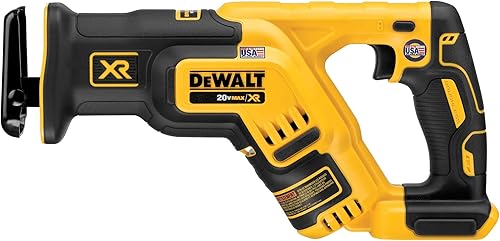
DeWalt 20V MAX XR Recip Saw: Best for work between studs
- Compact body
- Brushless motor
- 4-position blade clamp
- LED work light
A compact choice for framing spaces where blade orientation matters as much as body length. Its 4-position clamp gives you more ways to approach an awkward cut.
Pros
- Body designed for tight spots
- Four blade positions
- Variable-speed trigger
Cons
- Battery and charger sold separately
- Longer body than the Atomic pick
The DCS367B suits remodeling inside framing, where both body clearance and blade orientation affect access. Its 14.5 in body is designed for tight spots, and its keyless 4-position clamp lets you change your approach.
That clamp is the main reason to choose it over the Atomic. Rotating the blade position can help you line up a cut while keeping the saw body clear of nearby surfaces.
The brushless motor, LED and variable trigger round out the package, with a maximum of 2,900 SPM. It works with all DeWalt 20V MAX batteries and chargers, which are sold separately.
Buy this model when awkward approaches are a regular part of your work. Skip it if you mainly want the shortest one-handed saw, and measure the whole working space rather than assuming a compact body will fit every stud bay or cutting angle.
DeWalt 12 Amp Corded Recip Saw: Best for outlet-side demolition
- 12 amp motor
- Variable-speed trigger
- 4-position blade clamp
- Keyless lever-action clamp
Choose this corded saw for demolition where an outlet is available and battery changes would interrupt the work. The 4-position clamp also supports flush cutting.
Pros
- No battery charging needed
- Four blade positions
- Tool-free blade changes
Cons
- Requires a power outlet
- Cord needs a clear route around debris
The DWE305 makes sense for repeated cuts near an outlet, such as dismantling material in one work area. Its 12 amp motor removes battery capacity and charging from your work plan.
The keyless lever-action clamp offers four blade positions for flush cutting and other approaches. A variable-speed trigger lets you ease into a cut before increasing speed, rather than starting every cut at full pace.
Choose it when you can route the cord away from the blade, offcuts and your feet. For extension-cord selection, follow the saw manual's requirements for cord length and wire size.
Skip it if you regularly climb between work areas, move around a yard or cut where power is hard to reach. Corded power can support a steady workflow, but a tangled cable can slow a job more than a planned battery change.
DeWalt 20V MAX Recip Saw: Best for flush-cut remodeling
- 4-position blade clamp
- Variable-speed trigger
- Adjustable pivoting shoe
- Rubber overmold grip
A tool-only choice for remodelers who want blade-position options and an adjustable shoe. Buy it instead of the kit when you already have a compatible battery and charger.
Pros
- Four blade positions for awkward approaches
- Adjustable shoe controls blade exposure
- Tool-free blade changes
Cons
- Battery and charger sold separately
- Not the compact one-handed choice
The DCS380B fits remodelers who already have compatible batteries and want control over blade position and exposure. Its 4-position clamp supports flush-cut approaches, while the adjustable pivoting shoe changes how much blade extends beyond the support point.
That shoe is useful when you want to bring another section of teeth into contact with the work. It can also limit blade exposure, though it is not a precise depth stop for cutting near hidden services.
The variable trigger reaches up to 3,000 SPM, and the rubber overmold grip gives you a defined gripping surface. Choose a blade suited to the material instead of using maximum speed as your main buying reason.
This is the tool-only alternative to the DCS380P1 kit below. Skip it if you need a battery and charger from the start, or choose one of the compact models if reaching into confined framing matters more than adjustable blade exposure.
DeWalt 20V MAX Two-Finger Recip Saw: Best for mixed repair jobs
- Brushless motor
- Two-finger variable trigger
- Keyless twist-style blade clamp
- LED work light
A brushless option for buyers who prefer a two-finger trigger and twist-style blade changes. Its pivoting shoe helps maintain contact as the cutting angle changes.
Pros
- Two-finger speed control
- Twist-style blade changes
- LED and pivoting shoe
Cons
- Battery and charger sold separately
- Longer than the two compact picks
The DCS382B suits mixed repair and construction jobs when you prefer a two-finger variable trigger. Its twist-style keyless clamp also gives you a different blade-change action from the lever-style options.
The brushless motor, pivoting shoe and onboard LED cover useful everyday needs. The shoe helps maintain contact with the work as the cutting angle changes, while the trigger lets you start a kerf slowly.
At 16 in long, it needs more front-to-back room than either compact pick. It accepts DeWalt 20V MAX and FLEXVOLT batteries, so it can fit either battery collection without being a 60V MAX saw.
Choose it for that combination of controls and battery flexibility. Skip it if you specifically need the four blade positions offered by the DCS367B or DCS380B, and do not assume a two-finger trigger will suit every hand or grip preference.
DeWalt DCS384B XR Recip Saw: Best for demanding cordless demolition
- Brushless motor
- Variable-speed trigger
- Counterbalance designed to limit vibration
- TOOL CONNECT chip ready
Consider this XR saw for demanding cutting when vibration control is a buying priority. Its counterbalance mechanism is designed to limit vibration.
Pros
- Counterbalance mechanism
- Keyless lever-action blade clamp
- LED and pivoting shoe
Cons
- Battery and charger sold separately
- Long body needs more working room
The DCS384B XR is the pick for demanding cordless demolition when you want to stay with 20V MAX. Its counterbalance mechanism is designed to limit vibration, a useful feature to prioritize for repeated cutting.
The brushless motor works with a variable trigger reaching 3,000 max SPM at no load. A pivoting shoe, LED and keyless lever-action clamp support positioning, visibility and blade changes.
DeWalt claims up to 102 cuts per charge in 2 x 12 pine. Plan your battery supply around your actual materials and workload, since that figure is not a runtime promise for metal, mixed debris or every battery.
Its 19.3 in body needs room behind the cut, so skip it for cramped repair work where access is the main challenge. The TOOL CONNECT chip-ready system matters mainly for tool management; it requires a separate chip and should not drive a home repair buyer's choice.
DeWalt DCS380P1 Recip Saw Kit: Best for first-time cordless buyers
- Battery and charger included
- 4-position blade clamp
- Adjustable pivoting shoe
- Kit box included
This DCS380 package gets a new cordless buyer started with a battery, charger and kit box. Choose the tool-only version if you already have those essentials.
Pros
- Battery and charger included
- Four blade positions
- Adjustable shoe
Cons
- Duplicates accessories for established battery owners
- Only one battery included
The DCS380P1 is the straightforward choice for your first cordless reciprocating saw setup. It includes the DCS380 saw, a 5.0 Ah battery, DCB115 charger and kit box.
The buying difference from the DCS380B is the package, not a different cutting system. You get the same model's multi-position blade control and adjustable shoe without having to select the main power accessories separately.
One battery is enough to begin working, but it does not create an uninterrupted cutting cycle. If your project involves long stretches of cutting, plan charging breaks or a compatible spare rather than assuming the kit removes all downtime.
Choose this package when you need everything it includes. Skip it if you already own suitable batteries and a charger, or if the Atomic's compact shape solves your actual problem better than a larger saw bundled with accessories.
DeWalt FlexVolt DCS389B Recip Saw: Best for established FlexVolt users
- 60V MAX FlexVolt platform
- Variable-speed trigger
- Keyless lever-action blade clamp
- LED work light
A 60V MAX option for demanding work when you already have a suitable FlexVolt battery setup. It is a less convenient starting point for buyers who only own ordinary 20V MAX packs.
Pros
- Fits a 60V MAX FlexVolt setup
- Tool-free blade changes
- Pivoting shoe and LED
Cons
- Battery and charger sold separately
- Requires the correct 60V MAX-compatible battery
The DCS389B belongs on the shortlist for buyers already using 60V MAX FlexVolt tools. It offers a cordless route for demanding work without introducing another battery setup for those buyers.
Its variable-speed trigger, pivoting shoe and keyless lever-action clamp cover the main cutting controls. An LED helps illuminate the work area, and the rubber overmold grip provides a gripping surface.
DeWalt claims up to 19% more power than the DCS388. That is a comparison with one earlier model, so it does not rank this saw against every 20V MAX or corded option here.
Choose it when demanding cuts and an existing compatible battery setup justify the larger format. Skip it if you only have ordinary 20V MAX packs, mainly make small repair cuts or would need to build a separate power setup for occasional use.
How do you choose between DeWalt 20V MAX and FlexVolt?
Choose 20V MAX for an existing compatible battery collection or compact handling. Choose the DCS389B's 60V MAX FlexVolt setup when demanding work and suitable batteries make that route practical.
Battery fit is not simply a matter of seeing DeWalt on the label. A FLEXVOLT battery can serve compatible 20V MAX tools, but an ordinary 20V MAX pack cannot power a saw that requires 60V MAX.
Separate the saw purchase from the power plan. Check that you have a suitable charger, enough battery capacity for the job and somewhere appropriate to recharge.
Larger-capacity packs generally add bulk and weight, which can change how a saw handles in a tight space. Consider the assembled tool rather than judging comfort from bare-tool size alone.
For more on cordless features and tradeoffs, see our guide to choosing a cordless reciprocating saw. If you’re deciding whether a Sawzall-style tool is the right type, read is a Sawzall the same as a reciprocating saw?.
What should decide your DeWalt saw purchase?
Access, cut type and work duration should decide your purchase before smaller convenience features. Use your most common job as the reference, rather than buying around a rare task.
Choosing the best DeWalt reciprocating saw for access
Measure the space behind and beside the planned cut. Allow room for your hand, the installed battery, the blade's full movement and the tool's withdrawal after the cut.
Body length alone does not describe every access problem. A multi-position clamp may solve an awkward approach better than a shorter body if it lets the blade line up while the handle clears an obstruction.
A one-handed design also does not make holding the work in your free hand a sound plan. Secure the material and follow the manual's grip instructions for the cutting position.
Match blade controls to the cut
A pivoting shoe maintains support as the saw angle changes. An adjustable shoe adds another function by changing blade exposure and moving the working teeth along the blade.
Four blade positions help when you need a different approach to a nearby surface. Flush cutting still calls for a suitable blade and care around the surface you want to preserve.
A reciprocating saw favors removal work over clean finish cuts. For visible trim or a precise finished edge, choose a tool and blade intended for that result.
Compare workload rather than speed alone
SPM means strokes per minute, but maximum speed is only part of the cutting system. Blade choice, tooth condition, pressure and material support all affect progress.
A fast saw with a dull or unsuitable blade can chatter, wander or overheat the blade. Buy enough appropriate blades for the project before treating a higher maximum speed as the solution.
For occasional repairs, easy positioning may matter most. For repeated demolition, prioritize a stable grip, manageable vibration, power availability and a layout that lets you keep the shoe against the work.
How should you set up a DeWalt reciprocating saw?
Inspect the work area, isolate power and fit the right blade before starting. A careful setup prevents common problems such as loose blades, unsupported material and hidden obstructions.
- Check behind the cut. Locate wiring, pipes and other services before opening walls or cutting enclosed spaces.
- Disconnect power from the saw. Remove the battery or unplug the cord before fitting a blade or making adjustments.
- Select the blade. Match it to wood, nail-embedded wood, metal or another intended material.
- Seat and secure it. Follow the clamp instructions, then confirm it is locked while power remains disconnected.
- Support the work. Clamp loose material and arrange support so the cut will not close and pinch the blade.
- Check clearance. The blade must project beyond the far side throughout its stroke without striking anything behind it.
Wear eye protection and hearing protection, and manage dust for the material being cut. An LED helps you see the cut line, but it cannot reveal wiring or pipes hidden behind a surface.
If the clamp action is unfamiliar, follow our reciprocating saw blade-change guide. Let a hot blade cool before handling it.
Which blades and cutting habits make the biggest difference?
Use a material-specific blade, firm shoe contact and steady pressure. Those choices usually matter more than squeezing the trigger fully for every cut.
For clean wood, choose a wood-cutting blade with room between teeth to clear chips. For wood containing nails, use a blade intended for nail-embedded material instead of a clean-wood blade.
Metal needs a suitable metal-cutting blade, with several teeth engaged in thin material to reduce snagging. Follow the blade maker's guidance for tooth count, speed and any cutting lubricant.
Choose enough blade length to clear the material through the full stroke, but avoid needless extra length. A long unsupported blade has more room to flex, and its tip can hit objects behind the cut.
Start slowly to establish the kerf, then increase speed as appropriate. Keep the shoe against the work and let the teeth cut instead of forcing the saw forward.
Reduce pressure as the cut finishes so the tool does not lurch when the offcut releases. For more guidance on stance and cut control, read how to use a reciprocating saw.
Which common mistakes should you avoid?
Avoid forcing the cut, cutting with the shoe floating and choosing blades by length alone. These habits can cause chatter, bent blades and poor control.
Do not use maximum speed by default. Start under control, then match speed to the material and blade instructions, especially when beginning a metal cut.
Do not keep pushing through binding. Release the trigger, wait for the blade to stop and disconnect power before clearing the cause.
Do not confuse shoe adjustment with guaranteed cutting depth. Blade flex and changing tool angles still matter, so locate hidden services rather than relying on limited blade exposure.
Do not cut loose pipe or stock while holding it by hand. Secure it, support the offcut and keep hands clear of both the blade and the space beyond the work.
Do not ignore a worn blade. Replace it when damaged teeth, bending or slow progress continue despite correct setup, rather than adding more force.
How do you care for the saw between jobs?
Disconnect power, clear debris and inspect wear points after use. Basic care keeps chips from building up around the shoe and blade clamp.
Let the blade cool before removal, then clean the tool according to its manual. Keep vents clear and avoid forcing debris deeper into the housing.
Check the clamp for secure blade retention and inspect the shoe for damage. On the corded model, examine the cable and plug before the next job.
Store blades where their teeth cannot damage other gear or injure someone reaching into a box. Follow DeWalt's instructions for battery storage, charging and any model-specific lubrication rather than adding oil by guesswork.
Which DeWalt reciprocating saw should you choose?
Choose the DCS369B for compact repairs, the DCS367B for awkward framing cuts or the DWE305 for repeated work near an outlet. Choose the DCS380B when adjustable blade exposure matters and you already have power accessories, or the DCS380P1 when you need the complete starting package.
The DCS382B suits buyers who prefer its trigger and clamp controls. Put the DCS384B on your shortlist for demanding 20V MAX demolition, and the DCS389B for demanding work within an established 60V MAX FlexVolt setup.
The best DeWalt reciprocating saw is the one that reaches your work, uses a practical power source and gives you the blade controls you need. Before ordering, settle those three points and choose blades for your first project.
If compact access leads you to the Atomic, read our DCS369B review to check that choice against your planned cuts.
Our top 3 picks at a glance
-
1
-
2
-
3
Frequently asked questions
Which DeWalt reciprocating saw is best for tight spaces?
The DCS369B is the best fit for confined repair work because of its short body and one-handed design. Choose the DCS367B instead when you need several blade orientations between studs.
Measure room for the battery, blade movement and your grip before deciding which saw will fit.
Should you choose a corded or cordless DeWalt reciprocating saw?
Choose corded for repeated cutting near a reliable outlet, especially if you do not want to manage batteries. Choose cordless when you move between rooms or work away from power.
Include batteries and a charger in your buying plan, since most cordless choices here are tool-only.
Are DeWalt reciprocating saw batteries interchangeable?
Compatibility depends on the saw's voltage and battery requirements. The DCS367B accepts all DeWalt 20V MAX batteries, and the DCS382B accepts DeWalt 20V MAX and FLEXVOLT batteries.
The DCS389B requires a suitable 60V MAX FlexVolt pack; an ordinary 20V MAX battery is not a substitute.
What features matter most on a DeWalt reciprocating saw?
Working clearance, power source and blade controls matter most. Pick a body that fits your cutting position, then decide how you will power it.
A multi-position clamp helps with awkward approaches, while an adjustable shoe changes blade exposure.
Match the blade to the material before comparing maximum stroke speeds.
Do these DeWalt reciprocating saws include batteries?
The DCS380P1 kit includes a 5.0 Ah battery, charger and kit box. The other cordless picks here are tool-only, so plan for a compatible battery and charger.
One included battery gets you started, but longer projects may call for a spare to use while the first charges.


